
After you complete the 3-year or 5-year LL.B degree from a Bar Council of India-approved institute or if you’re in final semester of a 3-year or 5-year LL.B degree course and meet the other requirements, you’re eligible for the All India Bar Examination (AIBE).
Once you pass this certification exam, you get the Certificate of Practice (COP). This permits you to practice as an advocate in Indian Courts. Without passing the All India Bar exam, you cannot practice in any court.
Note: The All India Bar Examination is only for students graduating from the academic year 2009-10 onwards. If your law degree was awarded before the academic year 2009-10, there is no need to appear for the All India Bar Examination or qualify for this exam to practice law in India.
See this page till the end.
11 tips for passing AIBE
(Based on my personal experience)
Here are some important information and tips to keep in mind for the All India Bar Examination. These will ensure that you have an easy time sitting in the exam hall and are confident in solving the questions.
1. Starting with AIBE XVI, you can no longer take notes, printouts, or anything except physical Bare Acts books inside the AIBE exam hall. Therefore, make sure you have bought the Bare Act books that you can take inside.
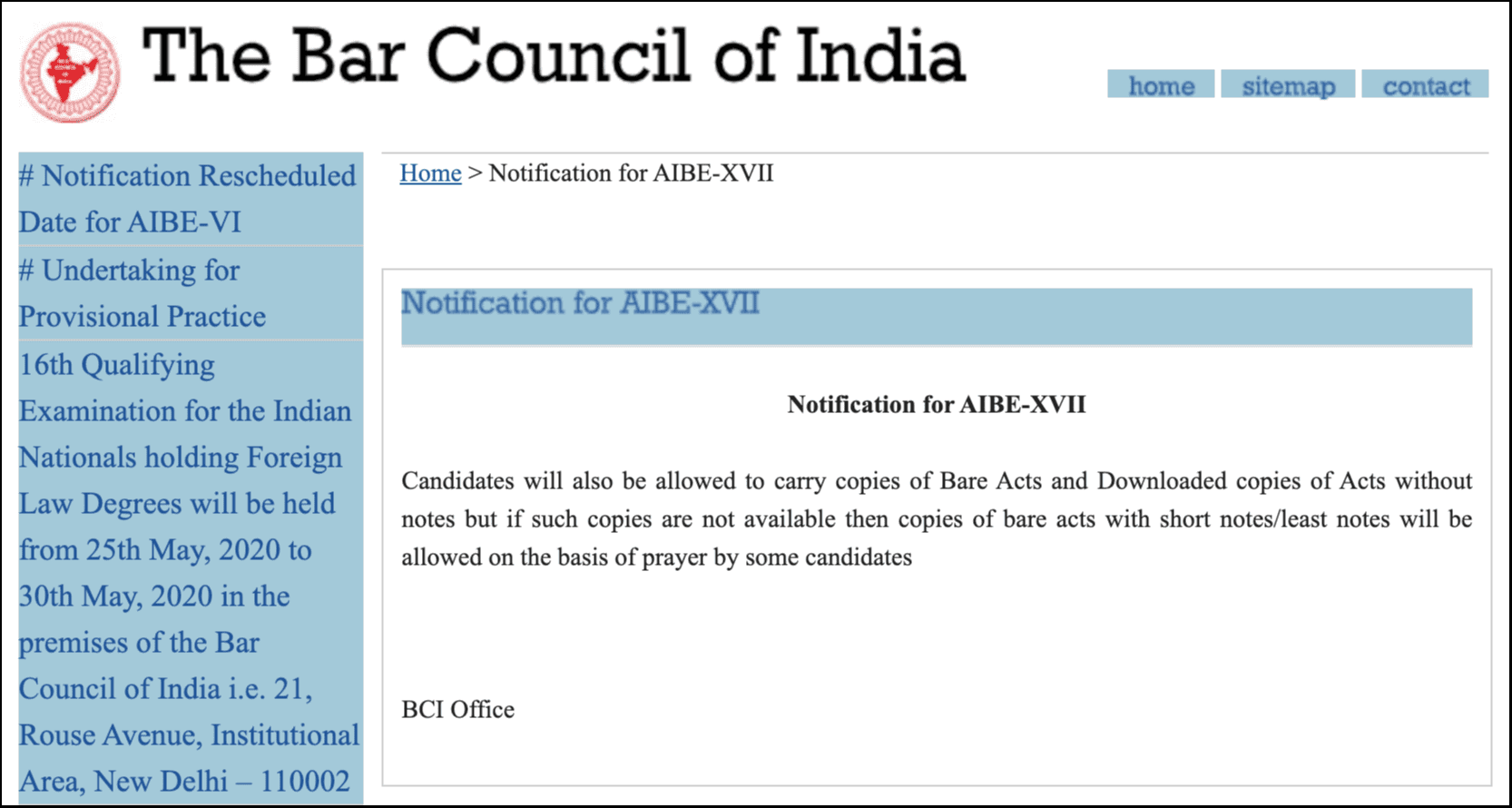
But the Bar Council of India updated the rules for AIBE-XVII and later. The Bar Council of India recommends you take physical, actual Bare Act books without notes. It also uses the term “downloaded copies,” meaning you may be able to take printouts (that’s what downloaded copies mean). Further, it says that if you can’t find Bare Acts without notes, then Bare Acts with short notes or least notes can be allowed if the candidate requests. Here’s the full official notification by the Bar Council of India.
2. There are 100 multiple-choice questions in AIBE. There is no negative marking. So, make sure you do not leave any questions unanswered.
3. You pass the All India Bar Exam if you get 40% of marks in the general category and 35% marks in the SC/ST category. That is, general category candidates have to get 40 out of 100 questions correct. SC/ST have to get 35 correct answers out of 100.
4. After the exam, you either pass or fail. Bar Council doesn’t show the exact marks you score.
5. Questions in AIBE are not very tough. They are challenging, but you can easily solve them.
6. You do not need any law notes for AIBE. Just focus on Bare Acts. Plus, with the syllabus subjects (given below), make sure you focus well on legal maxims and some of the landmark case laws.
7. If you have been reading Bare Acts and the syllabus subjects mentioned below for a few months, you are good to go. Plus, you will have the Bare Act books during the exam. So, it’s easy.
8. Read the questions carefully. Several of them can be solved just by reading the question and seeing the index page of the Bare Act of that question. Truly. Read the question! By the language and a few facts, you will get to know what the subject is. Now, open that Bare Act book’s index page and it should help you solve the question. If you need to dive more, quickly go to that Article or section using the page number mentioned in the index.
9. Personal Experience: Since this isn’t a competitive/job exam, people are usually friendly inside the hall. While I was taking the exam, candidates sitting near me gladly offered books I didn’t have, etc. So, overall, it was easy to solve the questions.
10. There are 100 questions, but if your language understanding (English or the language in which you are appearing) is good, you can solve them soon and will have ample time in the end to recheck.
11. Once again, in any case, do not leave any questions unanswered. Remember, there is no negative marking in AIBE!
Syllabus for AIBE
This is the syllabus for All India Bar Exam XX (2025) and later:
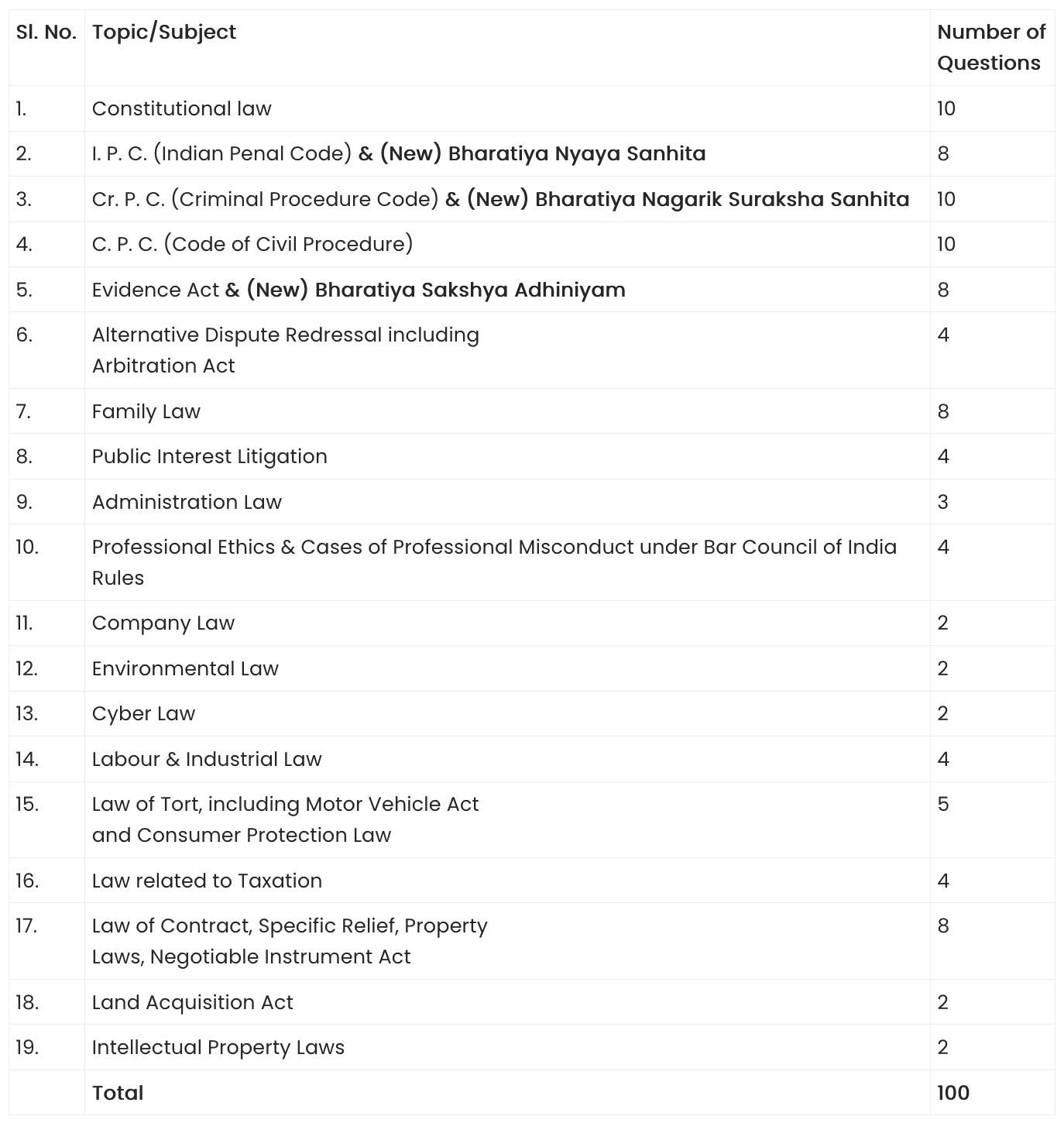
AIBE has a total of 100 questions from the subjects mentioned above, and the time duration for the exam is 3 hours 30 minutes.
Before appearing for it, make sure you read about the professional misconduct according to Advocates Act, 1961.
AIBE Bare Acts
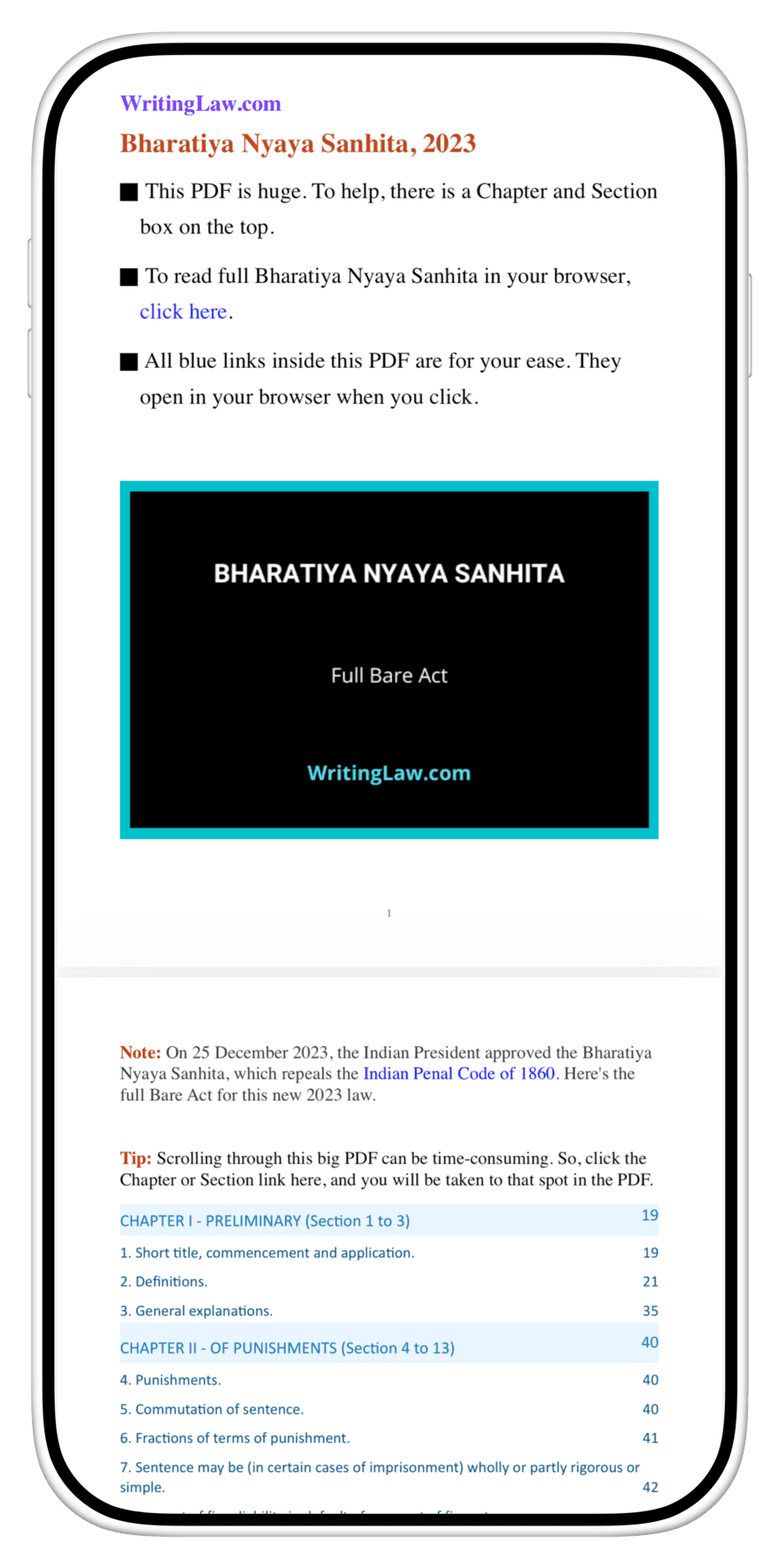
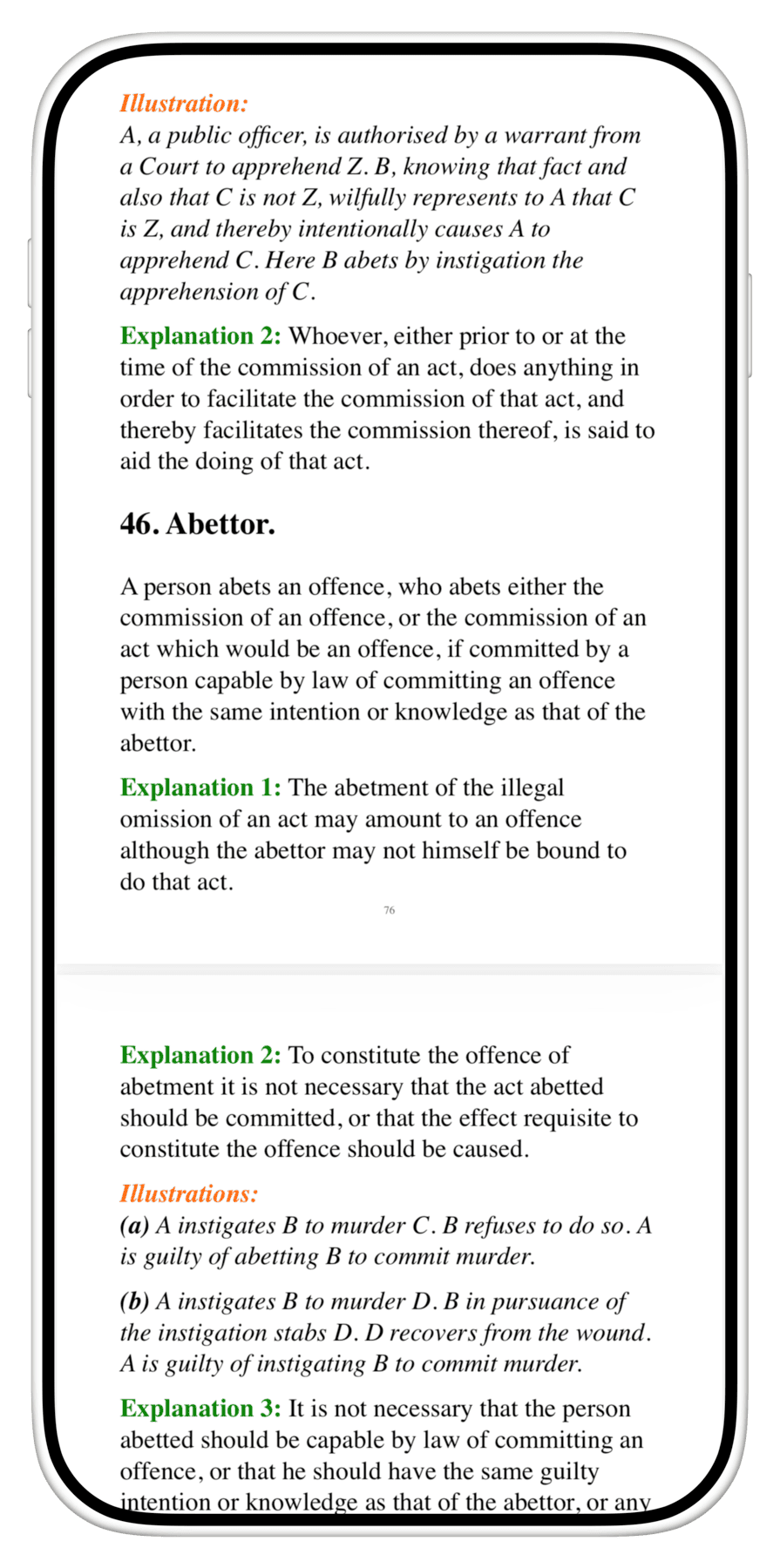
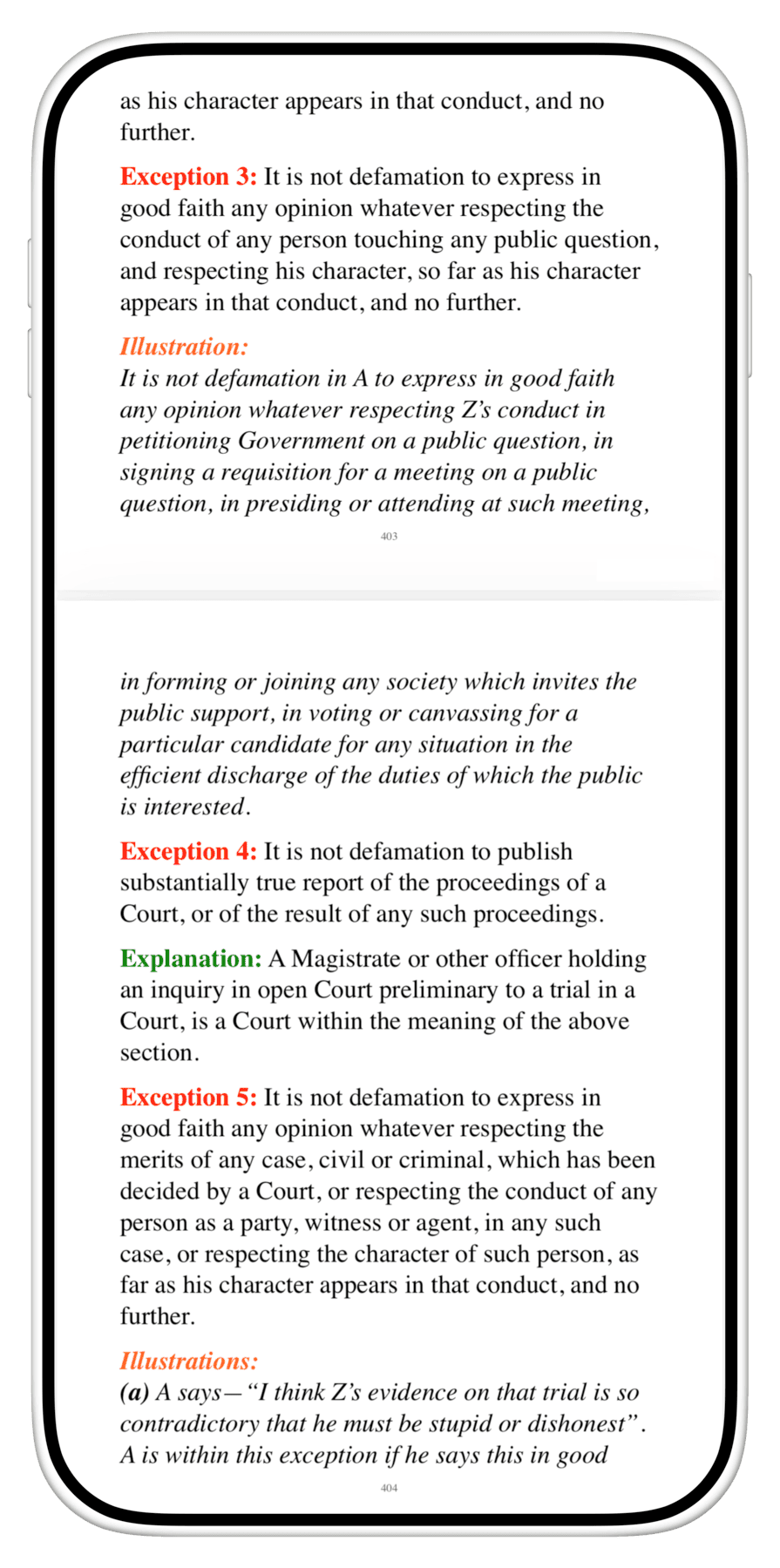
Out of the subjects mentioned above, WritingLaw has Bare Act PDFs for the following subjects. You cannot carry PDFs inside the exam hall but use them to study and prepare for AIBE now. You can buy these PDFs and many other PDFs for Rs 340. The Bare Act names are listed below.
List of AIBE Bare Acts We Have
These are useful throughout your legal career.
Constitution of India
Bharatiya Nyaya Sanhita 2023 + IPC 1860
Bharatiya Nagarik Suraksha Sanhita 2023 + CrPC 1973
Bharatiya Sakshya Adhiniyam 2023 + Evidence Act 1872
Civil Procedure Code 1908
Indian Contract Act 1872
Transfer of Property Act 1882
Family Laws (Hindu Laws)
Arbitration and Conciliation Act 1996
Advocates Act 1961
Motor Vehicles Act 2019
Specific Relief Act 1963
Consumer Protection Act 2019
Negotiable Instrument Act 1881
You can read from these Bare Act PDFs on your mobile, tablet and laptop to prepare for AIBE and all other law exams.
Practice Questions
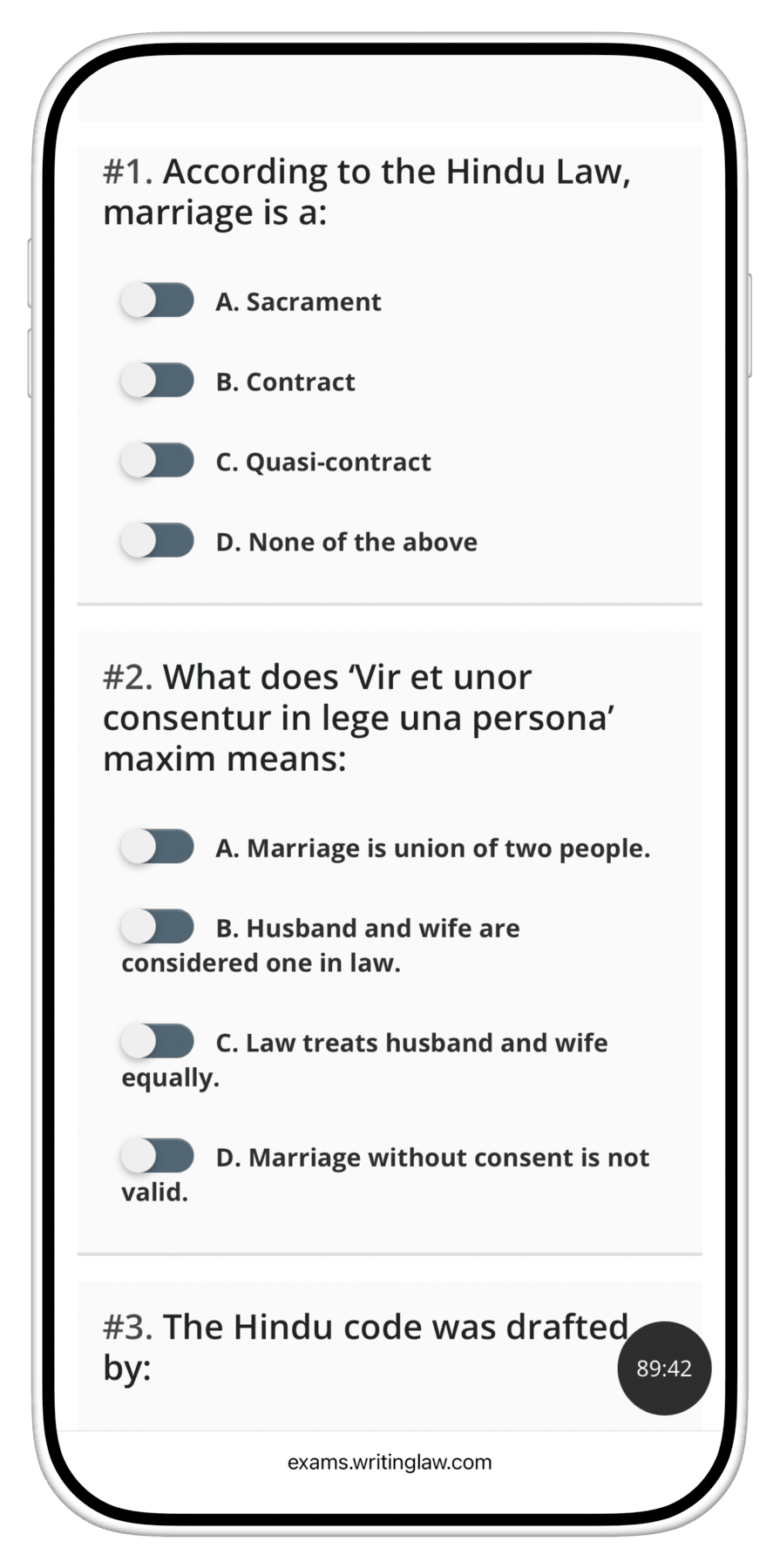
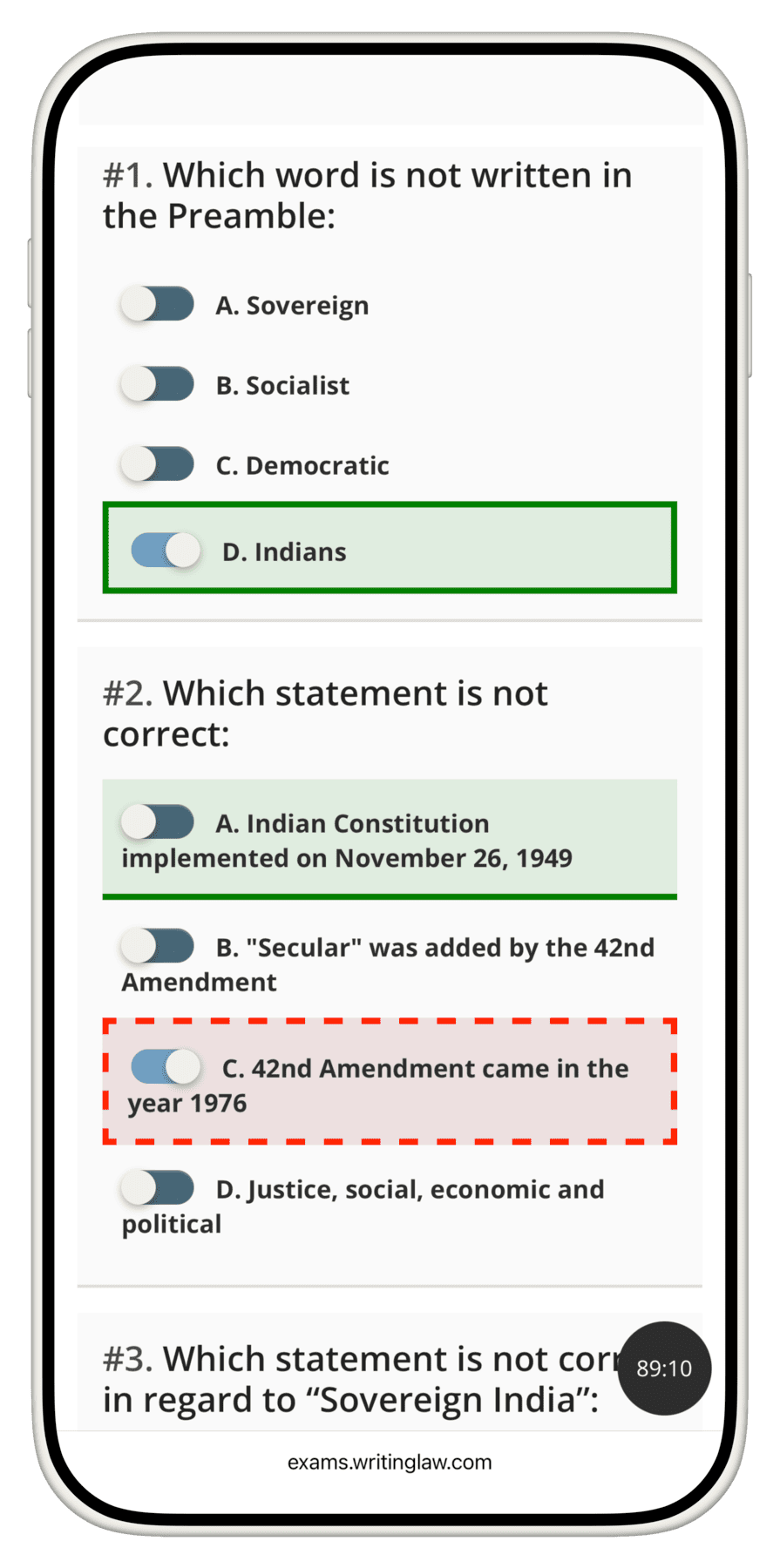
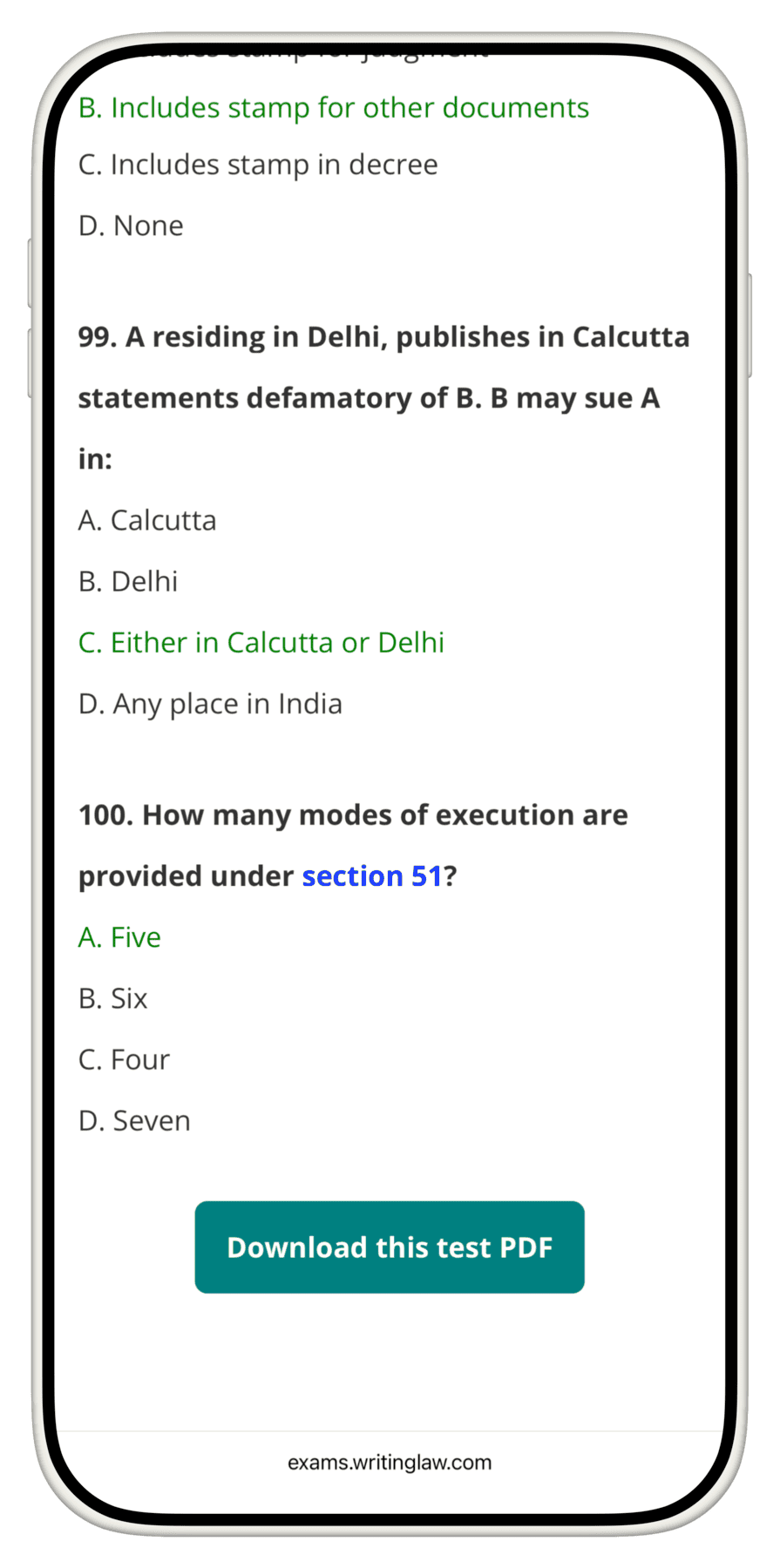
As mentioned above, AIBE has multiple-choice questions. Out of the above AIBE syllabus, WritingLaw has MCQ Tests on the following subjects. You can buy the Bare Act PDFs, the tests mentioned below, and several other things for Rs 1325.
These MCQ Tests have important questions that are of judiciary exam level. This makes them useful for all lower law exams, too. If you do well in these tests, passing AIBE and similar law exams should be easy for you.
Do not wait for the last moment or the one month before AIBE. For the best preparation, read from the Bare Acts and practice via the MCQ Tests starting today.
AIBE Tests We Offer
|
Constitution (1)
|
Constitution (2)
|
|
Civil Procedure Code (1)
|
Civil Procedure Code (2)
|
|
IPC (1)
|
IPC (2)
|
|
CrPC (1)
|
CrPC (2)
|
|
Evidence Act (1)
|
Evidence Act (2)
|
|
Hindu Laws
|
Contract Act
|
|
Specific Relief Act
|
Law of Torts
|
|
Muslim Law
|
Transfer of Property Act
|
|
Negotiable Instruments Act
|
Arbitration and Conciliation Act
|
These Mixed Tests Can Also Help
|
Test 1
|
Test 2
|
|
Test 3
|
Test 4
|
|
Test 5
|
Test 6
|
|
Test 7
|
Test 8
|
|
Test 9
|
Test 10
|
How to use WritingLaw’s Bare Acts and MCQ Tests to practice for AIBE
- Step 1: Open WritingLaw’s MCQ Tests on your phone or laptop.
- Step 2: Keep your Bare Act books near. Or, open WritingLaw’s Bare Act PDFs on another phone, laptop, or the same phone for now.
- Step 3: Start the MCQ test.
- Step 4: Solve the test questions by seeing the Bare Act books or PDFs.
- Step 5: Once done, see your test score. Anything above 50% in these tests is excellent for AIBE.
- Step 6: Take another test or refresh the page to retake this same test.
Names of Bare Act books may please be suggested. I think those students have passed the LLB before 2005, need not require to appear AIBE exam
The relevant Bare Act names are already mentioned in the post. If you are looking for good law books suggestions, please see this. And yes, those who passed LLB before 2005 do not have to appear in AIBE.