
Overview of Bharatiya Nagarik Suraksha Sanhita, 2023
2024-03-17
Read the overview of the Bharatiya Nagarik Suraksha Sanhita, 2023, comprehending its legislative journey and salient features.Read More →
Available on computer and big tablet screens.
For premium users
Read the overview of the Bharatiya Nagarik Suraksha Sanhita, 2023, comprehending its legislative journey and salient features.Read More →
The article explains the process of taking cognizance of an offence by Magistrates in the Indian legal system under CrPC.Read More →
Read the role of defence counsel in India’s criminal justice system, the right to legal representation and provisions for state-funded legal aid.Read More →
Public Prosecutor (PP) is defined in section 2(1)(u) of the Criminal Procedure Code, 1973. This law notes explains its roles and more.Read More →
The rights of the victim have been discussed under the Criminal Procedure Code from sections 357 to 358. This law note explains all about it.Read More →

Read about protest petition, which is a submission made by the victim to the court during or after the conclusion of the police investigation.Read More →
Hearing of the accused on the question of sentence is discussed in sections 235, 248(2) and 325 of the Indian Criminal Procedure Code.Read More →

In this law note, we will discuss the concept of “charge” in India as provided under the Code of Criminal Procedure, 1973.Read More →
Remission is defined as shortening the jail sentence of prisoners, and this law note tells you all about it as per the criminal law in India.Read More →

In this law article, you will read about statutory bail under the Criminal Procedure Code (CrPC) and the conditions to get it in India.Read More →

In this law note, you will learn about the trial of offences committed outside India and what’s the procedure for this.Read More →

In this law article, you will read about the powers of the Indian police in the matter of investigation as per the Criminal Procedure Code.Read More →
In this article, you will read about Public Prosecutors and the procedure of appointing a Public Prosecutor in India.Read More →

Download the CrPC (Criminal Procedure Code) PDF, which is thoughtfully made to save you time. This PDF is perfect for mobile, too.Read More →
Summon and warrant may appear similar, but they are different and in this CrPC law note, we tell you the five major differences between them.Read More →
Learn about bailable and non-bailable offence, cognizable and non-cognizable offence, compoundable and non-compoundable offence.Read More →
This CrPC law note explains the procedure of search by a police officer in India with or without a search warrant.Read More →
Alimony refers to the maintenance or financial support provided by the spouse after divorce. This brief Law article tells you more about it.Read More →
Summons in CrPC means “to appear and answer before the court”. This important Criminal Procedure Code law note tells you more about it.Read More →

Blanket orders are passed by High Courts to grant relief to a party by staying investigations and preventing arrests. Here’s more about it.Read More →

This important Criminal Procedure Code, 1973 law note tells you about Proclamation and Attachment dealt with under sections 82 to 86 of CrPC.Read More →

Let us analyse the law and focus on the provisions in the Indian laws to prosecute judges and public servants while holding their office.Read More →
The trial can be defined as a type of inquiry with the object to determine the guilt or innocence of the accused person. This CrPC law note tells you more.Read More →
Criminal appeal is discussed in Chapter 29 of the Criminal Procedure Code under sections 372 to 394. This CrPC law note tells you about it.Read More →
The provisions of bail are mentioned in Chapter XXXIII of the Criminal Procedure Code. This CrPC law note tells you everything about this.Read More →

Code of Criminal Procedure is an essential act, and many ask what is the scope, nature, and object of CRPC. Here is the precise answer.Read More →
When a person is arrested, he is taken to custody for questioning and further investigations. Let us learn about judicial custody and police custody.Read More →

Learn about Section 167 of the Criminal Procedure Code that provides for the procedure when investigation cannot be completed within 24 hours.Read More →

This law note tells you the rights and safeguards of an arrested person under the Indian Constitution and CrPC. Plus, the Supreme Court Guidelines.Read More →
Reference and revision have been discussed under chapter XXX of the Criminal Procedure Code, 1973, from sections 395 to 405.
Section 395 and section 396 of the Criminal Procedure Code, 1973 deal with reference. And sections 397 to 405 of the Criminal Procedure Code discuss revision.Read More →
The word revision is not defined in the code. The provisions for revision under the Criminal Procedure Code, 1973 are given under sections 397 to 405.
Under section 397 of the Criminal Procedure Code, the High Court and Court of Session have been empowered to call for and examine the records of any proceeding and satisfy oneself as to the:Read More →
Section 164 of the Criminal Procedure Code deals with the magistrate’s power to record a confession and other statements. The confession so recorded can be used as substantive evidence. In this law note, let us study the statements and confessions under section 164 CrPC.
A confession is a statement in which the suspect acknowledges his guilt of a crime.
A statement is the declaration of matter of fact.Read More →

Along with the rights granted to the accused, some legal protection is available as well. Protection to the accused is provided with a view of human dignity that is given to every citizen. This short law note states the legal protection that is available to an accused under a criminal trial. And, these can be stated as:
1. Doctrine of double jeopardy.
2. Presumption of innocence.
3. Doctrine of self-incrimination.Read More →
Section 2 – Definitions.
Section 6 – Classes of Criminal Courts.
Section 9 – Court of Session.
Section 10 – Subordination of Assistant Sessions Judges.
Section 11 – Courts of Judicial Magistrates.
Section 12 – Chief Judicial Magistrate and Additional Chief Judicial Magistrate, etc.Read More →
The pre-trial, trial and post-trial stages of the Criminal Procedure Code can be classified into three divisions based on the stage of the proceedings they deal with.Read More →
Arrest in the legal sense under CrPC means taking into custody of another person under the authority of law for the purpose of holding and detaining him to answer a criminal charge and preventing the commission of an offence.
Section 46 of CrPC prescribes the mode of arrest.Read More →

Inherent Powers are those powers that are not mentioned anywhere in the code. Inherent power or the inherent jurisdiction of the High Court may be exercised in a proper case either to prevent the abuse of the process of any court or to secure the ends of justice. These powers of the High Court should be used only in exceptional cases.
In the following cases, the inherent power of the High Court could be exercised to quash the proceedings-Read More →
Criminal courts can be categorised or classified (in the hierarchy) as given below:
1. Supreme Court.
2. High Court.
3. Courts of Sessions.
4. Judicial Magistrates of the First Class (called Metropolitan Magistrates in the metropolitan area).
5. Judicial Magistrates of Second Class.
6. Executive Magistrates.
Let us learn more about the six above-mentioned criminal courts.Read More →

The guidelines are as follows:
1. The police officer must take the prior written permission of the superior officer to go out of the state or union territory to carry out the investigation. He can take permission on the phone only in case of urgencies.
2. In cases where the police officer decides to arrest an accused in another state, he must write facts and reasons so as to satisfy why the arrest is necessary. The police officer must attempt to get an arrest or search warrant from the magistrate having jurisdiction.Read More →
According to section 125 of CrPC, a person having sufficient means is bound to maintain:-
I. His Wife (unable to maintain herself).
II. His legitimate or illegitimate minor child, whether married or not (unable to maintain himself/herself).
III. His legitimate or illegitimate child (not a married daughter) who has attained majority, if the child is physically or mentally abnormal or having any injury by which he/she is unable to maintain himself/herself.
IV. His father or mother (unable to maintain himself/herself)Read More →
According to Section 154 of the Criminal Procedure Code, FIR stands for First Information Report given orally or in writing to a police officer.Read More →

No statutory regulations have been provided in the Criminal Procedure Code to determine the nature of an offence as a cognizable or non-cognizable one. However, the code under Schedule I categorises certain offences as cognizable and non-cognizable ones.
Cognizable crimes are heinous in nature which embraces offences like rape, murder, theft, waging war etc. In cognizable cases, the information is given to the nearest police station, which registers the FIR and starts the investigation.Read More →

Offences listed under section 260(1)(i) to 260(1)(ix) can be tried summarily;
(i) offences not punishable with death, life imprisonment, or sentence of more than two years
(ii) theft (value of stolen goods not more than two thousand rupees)
(iii) receiving and retaining stolen property (the value of stolen goods not more than two thousand rupees)…Read More →

WHO IS AN INDIGENT PERSON?
Poor, Penniless, Pauper.
Order XXXIII of Civil Procedure Code provides remedy to those who need to institute a suit for enforcement of their rights but are so poor that they cannot afford expenses on court fee etc.
The object behind this order is that poverty should not come in way of getting justice.Read More →
The trial of summons case has been dealt with under Chapter 20 of the Criminal Procedure Code from section 251 to 259. According to section 2(w) of CrPC, summons cases are those cases that are not warrant cases. Summons cases are punishable with a fine or imprisonment of less than two years. Summons cases are triable only by Magistrate.
Under summons cases, it is not necessary to frame the charge in writing, stating the substance of the offence to the accused is enough. The particulars of the offence of which the person is accused are stated to him.Read More →

The concept of plea bargaining has been taken from USA. It was added in 2006. It is also one of the ways of ADR. (Alternative Dispute Resolution)
Who may apply for plea bargaining?
According to section 265B a person who is as accused of an offence may file an application for plea bargaining in the court in which such offence is pending for trial.Read More →

In general, a warrant is an order that serves as a specific type of authorisation issued by a Court or Magistrate directed to the police or any other authority to enable them to arrest, search a premise etc. As discussed earlier, the attendance of the accused can be procured by:
1. summon
2. arrest or detention
3. proclamation and attachmentRead More →
Section 144 of the Criminal Procedure Code is a technical tool to maintain security and peace in the society.
Section 144 of CrPC is imposed in urgent cases of apprehended danger of nuisance or disturbance in peace.
It is frequently in the news. Let us look at some leading questions and confusion related to section 144 of CrPC.Read More →
Maintenance means to give necessary supplies to a person for survival. It includes shelter, food, and clothing, and every aspect of human life, which is essential for survival and existence.
Section 125 of the Criminal Procedure Code, 1908, provides maintenance for the wife, children, and parents.
Section 125 of CrPC is secular in nature.Read More →
Law Question: Can the police officer investigate his own case where he himself is the informant of the case?
Answer: Yes, a police officer can be an informant in a case.
A police officer may always take information suo-motu of any case, be it a cognizable case or non-cognizable case.Read More →

FIR is not defined in CrPC.
It may be defined under the following points-
1. It is a piece of information that is given to the police officer.
2. The information must relate to a cognizable offence.Read More →

This trial is divided into two parts.
1. Trial of warrant cases by magistrate where case instituted on a police report: Sections 238 to 243, 248, 249, 250.
2. Trial of warrant cases instituted otherwise than on a police report: Sections 244-250Read More →
The complainant fills a protest petition, and on that basis, the court takes the cognizance of the offence.
So what procedure court will follow, whether it is a case instituted on the police report or on the complaint, since a protest petition is treated as a complaint by the magistrate?Read More →
Difference Between Complaint and FIR
Difference Between Trial and Inquiry
Difference Between Investigation and InquiryRead More →
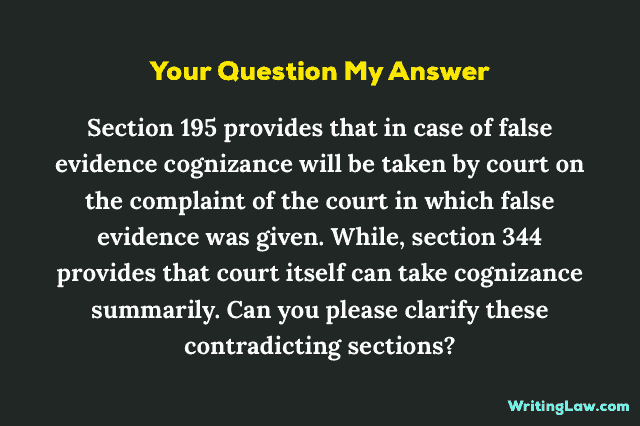
Section 195 and 344 are different in there own spheres. No section is inter-related or intervening to that of another.
Section 340 prescribes the procedure as to how a complaint is to be made under section 195.Read More →

1. A trial is always for an offence. An inquiry does not necessarily relate to only offences.
2. A trial ends in acquittal or conviction of an accused. An inquiry into a offence never ends in a conviction or acquittal.
3. Trial is the examination and determination of cause by a judicial tribunal. Inquiry includes every inquiry other than a trial conducted by magistrate or court.Read More →

According to section 265C of CrPC, in working out a mutually satisfactory disposition, the court shall follow the following procedure.
When a case is instituted on a police report, the court shall issue notice to the public prosecutor, the P.O/I.O (police officer/investigating officer) who has investigated the case, the accused and the victim of the case to participate in the meeting to work our a satisfactory disposition of the case.Read More →

1. Offence where punishment is not more than 7 years.
2. The offence which are not against the women and children.
3. The offence which does not affect the socio-economic condition of the country.
The central government has determined the offences which are affecting the socio economic condition of country-
Dowry Prohibition Act, 1961Read More →
1. An investigation is made by a police officer or by some person authorised by a magistrate.
1. An inquiry is made by magistrate or court.
Investigation is never made by magistrate or court.Read More →

CHAPTER I, Section 1 to 5 of CRIMINAL PROCEDURE CODE (CRPC) – PRELIMINARY An Act to consolidate and amend the law relating to Criminal Procedure.Read More →

CHAPTER II, Section 6 to 25A of CRIMINAL PROCEDURE CODE (CRPC) – CONSTITUTION OF CRIMINAL COURTS AND OFFICES 6. Classes of Criminal Courts. Besides theRead More →
CHAPTER III, Section 26 to 35 of CRIMINAL PROCEDURE CODE (CRPC) – POWER OF COURTS 26. Courts by which offences are triable. Subject to theRead More →
CHAPTER IV, Section 36 to 40 of CRIMINAL PROCEDURE CODE (CRPC) A) POWERS OF SUPERIOR OFFICERS OF POLICE 36. Powers of superior officers of police.Read More →
CHAPTER V, Section 41 to 60A of CRIMINAL PROCEDURE CODE (CRPC) – ARREST OF PERSONS 41. When police may arrest without warrant. (1) Any policeRead More →
CHAPTER VI, Section 61 to 90 of CRIMINAL PROCEDURE CODE (CRPC) – PROCESSES TO COMPEL APPEARANCE A—Summons 61. Form of summons. Every summons issued byRead More →
CHAPTER VII, Section 91 to 105 of CRIMINAL PROCEDURE CODE (CRPC) – PROCESSES TO COMPEL THE PRODUCTION OF THINGS A—Summons to produce 91. Summons toRead More →

CHAPTER VIIA, Section 105A to 105L of CRIMINAL PROCEDURE CODE (CRPC) – RECIPROCAL ARRANGEMENTS FOR ASSISTANCE IN CERTAIN MATTERS AND PROCEDURE FOR ATTACHMENT AND FORFEITURERead More →

CHAPTER VIII, Section 106 to 124 of CRIMINAL PROCEDURE CODE (CRPC) – SECURITY FOR KEEPING THE PEACE AND FOR GOOD BEHAVIOUR 106. Security for keepingRead More →
CHAPTER IX, Section 125 to 128 of CRIMINAL PROCEDURE CODE (CRPC) – ORDER FOR MAINTENANCE OF WIVES, CHILDREN AND PARENTS 125. Order for maintenance ofRead More →
CHAPTER X, Section 129 to 148 of CRIMINAL PROCEDURE CODE (CRPC) – MAINTENANCE OF PUBLIC ORDER AND TRANQUILLITY A—Unlawful assemblies 129. Dispersal of assembly byRead More →
CHAPTER XI, Section 149 to 153 of CRIMINAL PROCEDURE CODE (CRPC) – PREVENTIVE ACTION OF THE POLICE 149. Police to prevent cognizable offences. Every policeRead More →
CHAPTER XII, Section 154 to 176 of CRIMINAL PROCEDURE CODE (CRPC) – INFORMATION TO THE POLICE AND THEIR POWERS TO INVESTIGATE 154. Information in cognizableRead More →
CHAPTER XIII, Section 177 to 189 of CRIMINAL PROCEDURE CODE (CRPC) – JURISDICTION OF THE CRIMINAL COURTS IN INQUIRIES AND TRIALS 177. Ordinary place ofRead More →
CHAPTER XIV, Section 190 to 199 of CRIMINAL PROCEDURE CODE (CRPC) – CONDITIONS REQUISITE FOR INITIATION OF PROCEEDINGS 190. Cognizance of offences by Magistrates. (1)Read More →
CHAPTER XV, Section 200 to 203 of CRIMINAL PROCEDURE CODE (CRPC) – COMPLAINTS TO MAGISTRATES 200. Examination of complainant. A Magistrate taking cognizance of anRead More →
CHAPTER XVI, Section 204 to 210 of CRIMINAL PROCEDURE CODE (CRPC) – COMMENCEMENT OF PROCEEDINGS BEFORE MAGISTRATES 204. Issue of process. (1) If in theRead More →
CHAPTER XVII, Section 211 to 224 of CRIMINAL PROCEDURE CODE (CRPC) – THE CHARGE A—Form of charges 211. Contents of charge. (1) Every charge underRead More →

CHAPTER XVIII, Section 225 to 237 of CRIMINAL PROCEDURE CODE (CRPC) – TRIAL BEFORE A COURT OF SESSION 225. Trial to be conducted by PublicRead More →
CHAPTER XIX, Section 238 to 250 of CRIMINAL PROCEDURE CODE (CRPC) – TRIAL OF WARRANT CASES BY MAGISTRATES A—Cases instituted on a police report 238.Read More →
CHAPTER XX, Section 251 to 259 of CRIMINAL PROCEDURE CODE (CRPC) – TRIAL OF SUMMONS CASES BY MAGISTRATES 251. Substance of accusation to be stated.Read More →
CHAPTER XXI, Section 260 to 265 of CRIMINAL PROCEDURE CODE (CRPC) – SUMMARY TRIALS 260. Power to try summarily. (1) Notwithstanding anything contained in thisRead More →

CHAPTER XXIA, Section 265A to 265L of CRIMINAL PROCEDURE CODE (CRPC) – PLEA BARGAINING 265A. Application of the Chapter. (1)This Chapter shall apply in respectRead More →
CHAPTER XXII, Section 266 to 271 of CRIMINAL PROCEDURE CODE (CRPC) – ATTENDANCE OF PERSONS CONFINED OR DETAINED IN PRISONS 266. Definitions. In this Chapter-Read More →
CHAPTER XXIII, Section 272 to 299 of CRIMINAL PROCEDURE CODE (CRPC) – EVIDENCE IN INQUIRIES AND TRIALS A-Mode of taking and recording evidence 272. LanguageRead More →
CHAPTER XXIV, Section 300 to 327 of CRIMINAL PROCEDURE CODE (CRPC) – GENERAL PROVISIONS AS TO INQUIRIES AND TRIALS 300. Person once convicted or acquittedRead More →
CHAPTER XXV, Section 328 to 339 of CRIMINAL PROCEDURE CODE (CRPC) – PROVISIONS AS TO ACCUSED PERSONS OF UNSOUND MIND 328. Procedure in case ofRead More →

CHAPTER XXVI, Section 340 to 352 of CRIMINAL PROCEDURE CODE (CRPC) – PROVISIONS AS TO OFFENCES AFFECTING THE ADMINISTRATION OF JUSTICE 340. Procedure in casesRead More →
CHAPTER XXVII, Section 353 to 365 of CRIMINAL PROCEDURE CODE (CRPC) – THE JUDGMENT 353. Judgment. (1) The judgment in every trial in any CriminalRead More →
CHAPTER XXVIII, Section 366 to 371 of CRIMINAL PROCEDURE CODE (CRPC) – SUBMISSION OF DEATH SENTENCES FOR CONFIRMATION 366.Sentence of death to be submitted byRead More →

CHAPTER XXIX, Section 372 to 394 of CRIMINAL PROCEDURE CODE (CRPC) – APPEALS 372. No appeal to lie unless otherwise provided. No appeal shall lieRead More →
CHAPTER XXX, Section 395 to 405 of CRIMINAL PROCEDURE CODE (CRPC) – REFERENCE AND REVISION 395. Reference to High Court. (1) Where any Court isRead More →
CHAPTER XXXI, Section 406 to 412 of CRIMINAL PROCEDURE CODE (CRPC) – TRANSFER OF CRIMINAL CASES Law Note: Transfer of Cases under Sections 406 toRead More →

CHAPTER XXXII, Section 413 to 435 of CRIMINAL PROCEDURE CODE (CRPC) – EXECUTION, SUSPENSION, REMISSION AND COMMUTATION OF SENTENCES A – Death Sentences 413. ExecutionRead More →
CHAPTER XXXIII, Section 436 to 450 of CRIMINAL PROCEDURE CODE (CRPC) – PROVISIONS AS TO BAIL AND BONDS 436. In what cases bail to beRead More →
CHAPTER XXXIV, Section 451 to 459 of CRIMINAL PROCEDURE CODE (CRPC) – DISPOSAL OF PROPERTY 451. Order for custody and disposal of property pending trialRead More →
CHAPTER XXXV, Section 460 to 466 of CRIMINAL PROCEDURE CODE (CRPC) – IRREGULAR PROCEEDINGS 460. Irregularities which do not vitiate proceedings. If any Magistrate notRead More →
CHAPTER XXXVI, Section 467 to 473 of CRIMINAL PROCEDURE CODE (CRPC) – LIMITATION FOR TAKING COGNIZANCE OF CERTAIN OFFENCES 467. Definitions. For the purposes ofRead More →
CHAPTER XXXVII, Section 474 to 484 of CRIMINAL PROCEDURE CODE (CRPC) – MISCELLANEOUS 474. Trials before High Court. When an offence is tried by theRead More →

FIRST SCHEDULE OF CRIMINAL PROCEDURE CODE (CRPC) I am extremely preoccupied and busy with other bare acts and other maintenance works for this website. IRead More →

SECOND SCHEDULE OF CRIMINAL PROCEDURE CODE (CRPC) I am extremely preoccupied and busy with other bare acts and other maintenance works for this website. IRead More →
My name is Ankur. I am a law graduate. I was my college topper for five years. In March 2018, I started WritingLaw.com. The main motive was to make a modern law website that is nice, clean, and comfortable.
Everything is going well. This is because of law students, advocates, judges and professors like you, who give me satisfaction, hope and the motivation to keep working.
Thank you for visiting us today. I hope you have a fruitful time here.
© 2018-2026 WritingLaw.com | Sitemap
Log In to your premium account