Difference Between Trial and Inquiry, CrPC

1. A trial is always for an offence. An inquiry does not necessarily relate to only offences.

2. A trial ends in acquittal or conviction of an accused. An inquiry into a offence never ends in a conviction or acquittal.

3. Trial is the examination and determination of cause by a judicial tribunal. Inquiry includes every inquiry other than a trial conducted by magistrate or court.Read More →

Mutual Satisfactory Disposition

According to section 265C of CrPC, in working out a mutually satisfactory disposition, the court shall follow the following procedure.

When a case is instituted on a police report, the court shall issue notice to the public prosecutor, the P.O/I.O (police officer/investigating officer) who has investigated the case, the accused and the victim of the case to participate in the meeting to work our a satisfactory disposition of the case.Read More →

Cases where plea bargaining is allowed

1. Offence where punishment is not more than 7 years.

2. The offence which are not against the women and children.

3. The offence which does not affect the socio-economic condition of the country.

The central government has determined the offences which are affecting the socio economic condition of country-
Dowry Prohibition Act, 1961Read More →

Ocular oral and documentary

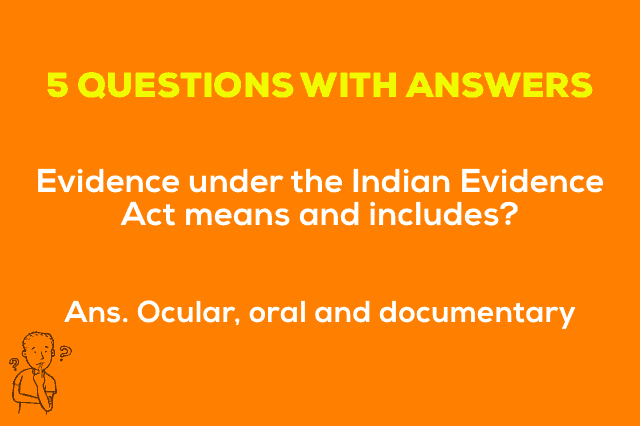
1. Evidence under the Evidence Act means and includes?
Ans. Ocular, oral and documentary. (Ocular means ‘connected with eyes or vision’)

2. The Indian Evidence Act has been divided into how many chapters and parts?
Ans. 3 Parts, 11 ChaptersRead More →

20 Law Questions

PDF for 20 law question and answers. These question are very short and and have one word or one sentence answers. These questions are important for various competitive law exams.

The 20 law questions in this PDF are mixed and of all kinds.
This randomness helps you prepare for exams that have multiple choice questions.Read More →