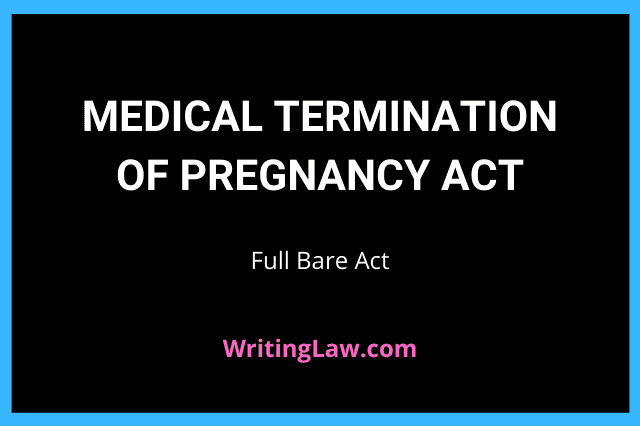
Medical Termination of Pregnancy Act, 1971
2023-03-19
Medical Termination of Pregnancy Act An Act to provide for the termination of certain pregnancies by registered medical practitioners and for matters connected therewith orRead More →

WritingLaw offers important Bare Acts, PDFs, law notes, law Q&A, articles, and MCQ practice tests for students, advocates, and people in the legal field.
Medical Termination of Pregnancy Act An Act to provide for the termination of certain pregnancies by registered medical practitioners and for matters connected therewith orRead More →
Learn about the various duties of an Indian advocate towards the court, his client, the opposition, and his fellow advocates.Read More →
Hearsay evidence means any information which a person gathers or collects from a person who has first-hand knowledge of that fact or information.Read More →
Here is the full list of important Sections and Orders of CPC for all law exams. Section 2. Definitions. Section 6. Pecuniary jurisdiction.Read More →
A law student must be well updated with the parliamentary proceedings and certain terms concerning the parliament. Look at some unique terms.Read More →

To prepare well for your law exams and advocacy, here are the most important Articles of the Indian Constitution and the PDF to read them.Read More →
Download the PDF for the Constitution of India. The Indian Constitution PDF is systematic, colourful, and perfect for mobile.Read More →
Here are eight tips to prepare for the General Studies (GS) paper in the state judicial exams, judiciary, and other law competitive exams.Read More →

1. Make a daily habit of reading Bare Acts. 2. If you do not understand something, read it ten times. I bet you will start understanding.Read More →

Download the CrPC (Criminal Procedure Code) PDF, which is thoughtfully made to save you time. This PDF is perfect for mobile, too.Read More →
Here is a beautiful, colourful and useful PDF having 100 short questions with answers which are important for judiciary exams and law exams.Read More →

Section 2 – Interpretation-clause.
Section 3 – Communication, acceptance and revocation of proposals.
Section 4 – Communication when complete.
Section 5 – Revocation of Proposals and acceptance.
Section 6 – Revocation how made.
Section 10 – What agreements are contracts?
Section 11 – Who are competent to contract?Read More →
The Constitution of India is an important subject. Here are the best books to understand it for beginners, law students, and UPSC aspirants.Read More →
366. Definitions. In this Constitution, unless the context otherwise requires, the following expressions have the meanings hereby respectively assigned to them, that is to say-Read More →
342A. Socially and educationally backward classes. (Added by 102nd amendment in 2018) Here is the full 102nd Amendment Act PDF. Please give it a look. (1)Read More →
338B. National Commission for Backward Classes. (This section has been added by 102nd amendment in 2018). Here is the full 102nd Amendment Act PDF. (83KB)Read More →