Can a Person Be Punished for Violating Home Quarantine?
2021-07-25
If the government’s order is not followed or disobeyed, then the person may be punished as per section 188 of IPC.Read More →
If the government’s order is not followed or disobeyed, then the person may be punished as per section 188 of IPC.Read More →
There is nothing to eat so they said that we will do the act of cannibalism but while saying the word cannibalism D was in unconscious mind.
Cannibalism is the act of consuming another individual of the same species as food. In this question human eating human.
Will they be punished and what will be the punishment?Read More →

The doctor is liable, and he cannot claim protection under Section 81 of IPC because every person is sovereign (head) of his body. The Doctrine of Necessity applies to cause small harm to avoid big harm.
A doctor can only advise the attendant to donate his blood. He can not compel the attendant to do so.Read More →
Download PDF for 50 important law questions and answers for leading law exams, other law competitions, and more.Read More →
1. By which amendment was the Sindhi language added in the VIII Schedule of the Constitution?
Ans. 21st Amendment, 1967.
2. Which case is related to live streaming of the proceedings of Supreme Court?
Ans. Swapnil Tripathi vs SC of India.Read More →
Where the eyewitnesses account is found credible and trustworthy, a medical opinion pointing to the alternative possibilities cannot be accepted as conclusive.
So we can conclude that the court does not neglect any evidence. It considers all pieces of evidence put before it and relies on that which is worthy of credit and trust.Read More →
Law Question: Can the police officer investigate his own case where he himself is the informant of the case?
Answer: Yes, a police officer can be an informant in a case.
A police officer may always take information suo-motu of any case, be it a cognizable case or non-cognizable case.Read More →
Section 85 and section 86 of the Indian Penal Code deal with the general defence to a person who commits an offence under intoxication.
Section 85 of IPC exempts a person from punishment provided that he committed the crime under the influence of intoxication where he had been intoxicated without his knowledge and against his will – that is involuntary intoxication.Read More →

Relevant facts are those facts which are logical and relate to the facts of the case. They are admissible only if they are connected to the facts in issue.
Relevancy of facts is seen and judged from the connection they have with the case. Section 6 to section 55 of the Indian Evidence Act deals with the relevancy of facts.Read More →
Section 107 to section 120 of the Indian Penal Code deal with abetment. Abetment of an offence is itself an offence as described in section 107 of IPC.
If any person instigates, aids, or conspire for the commission of an offence, he is said to have committed offence of abetment.Read More →
Motive is the ulterior element for committing a crime. It is something that makes a person commit a crime.
For example, If A and B are enemies for the last 10 years. And one day A kills B. From their previous relation, it can be assumed that what could be the reason for A to kill B. For every crime, there is a reason, and that is motive.Read More →
The complainant fills a protest petition, and on that basis, the court takes the cognizance of the offence.
So what procedure court will follow, whether it is a case instituted on the police report or on the complaint, since a protest petition is treated as a complaint by the magistrate?Read More →
A the master and B the servant, are being jointly tried for the murder of X and also after that for having made away with the dead body to hide and crime (Section 302 and 201 IPC).
B confesses about the crime during the trial.
Is this confession relevant against A? Give reasons for or against.Read More →

Section 19 of IPC includes every person who is empowered by law to give a judgment, be it judicial authority or quasi-judicial authority.
Whereas in section 20 of IPC, the term court of justice includes a person who is empowered by law to act judicially alone and not otherwise.Read More →
1. Indian Partnership Act came into force on?
Ans. 1 October 1932
2. As per Indian Partnership Act, Business includes?
Ans. Trade, Occupation and ProfessionRead More →

A mortgage as per section 58 of Transfer of Property Act is transfer of an interest in immovable property for securing payment of debt.
On the expiration of due date it becomes duty of mortgagor to repay the amount of loan to mortgagee and redeem the property mortgaged.Read More →
1. Who is considered as father of Indian evidence act?
Ans. James Stephen.
2. “Evidence is to be weighed and not counted” attracts which section of Evidence act?
Ans. Section 134.Read More →
1. Code of Criminal Procedure is a subject matter of which list?
Ans. Concurrent List
2. For how many years a person has to be a High Court judge to become a Supreme Court Judge?
Ans. FiveRead More →
1. By which amendment was the Sindhi language added in the VIII schedule of the constitution?
Ans. 21st Amendment, 1967
2. Which case is related to live streaming of the proceedings of supreme court?
Ans. Swapnil Tripathi vs SC of IndiaRead More →
1. Which provision of Evidence Act reflects for the application of the principle of res judicata?
Ans. Section 40
2. ‘A’ is charged with travelling on a railway without a ticket. The burden of proving that ‘A’ had a ticket is on?
Ans. ‘A’Read More →
Question asked by one of you:
I have a doubt about the maxim jus necessitatis. Does it come under section 81 or 87 of IPC?
Answer:
This is called the doctrine of necessity. It means a person doing a thing under compulsion of situation. It is not considered a wrongful act. It comes under the ambit of section 81 of IPC.Read More →

After death of a partner can his wife or his legal heir be a partner of that partnership firm?
WritingLaw’s answer-
Section 42(C) of Partnership Act talks about ‘Dissolution of firm on the death of a partner.’
If there is no contract to the contrary then partnership automatically dissolves on the death of a partner.Read More →
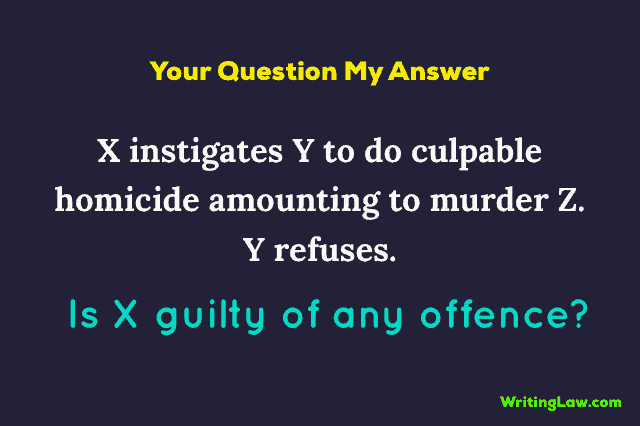
Question asked by a student-
Please send me answer for-
X instigates Y to do culpable homicide amounting to murder Z. Y refuses. Is X guilty of any offence?
Answer by WritingLaw-
Yes of abetment.
Why…?Read More →
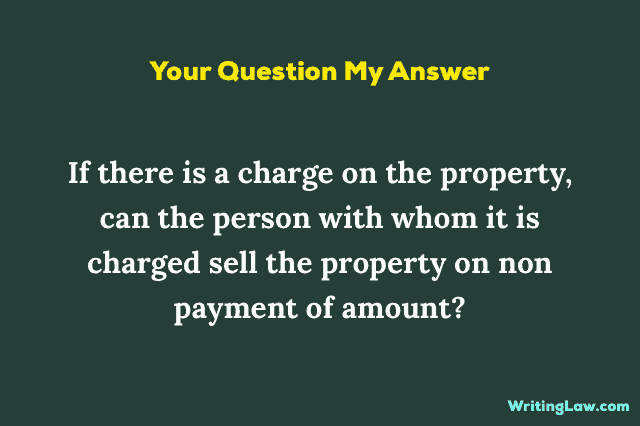
Charge is where immovable property of one person is made security for the payment of money to another.
It refers to the security for securing the debt, by way of pledge, hypothecation and mortgage.Read More →

India received the award of excellence for ‘Best in show’ at the New York times 2019. It is the largest travel show in north America.
Vijaywada railway station has received gold rating by the Indian Green Building Council (IGBC) for green measures.Read More →
1. Which period is considered as the Golden Age of India?
Ans. The Gupta Empire (320-520CE)
2. Who is also known as the Shakespeare of India?
Ans. KalidasaRead More →

1. The evidence unearthed by sniffer dog falls under?
Ans. Scientific Evidence
2. All the confessions are admissions but all the admissions are not confessions. State whether statement is True or False.
Ans. TrueRead More →
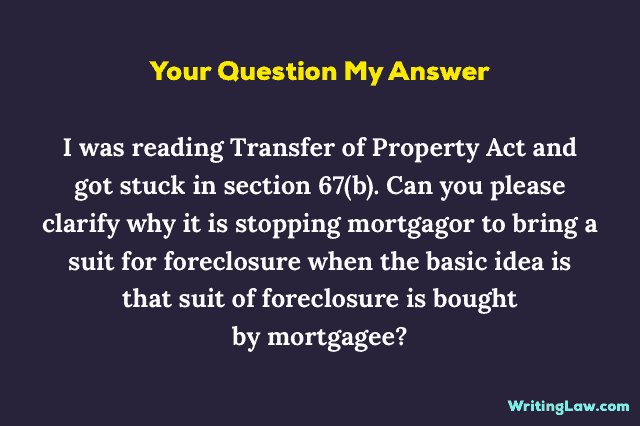
The right of foreclosure is available to mortgagee under section 67 of Transfer of Property Act to recover his money due on mortgagor.
This right can be exercised only when-
The debt amount has become due for payment.
There should be no other contract contrary to the mortgage deed, else the terms and conditions of contract will suffice.
Where mortgagor has not got a degree of redemption under section 60.Read More →
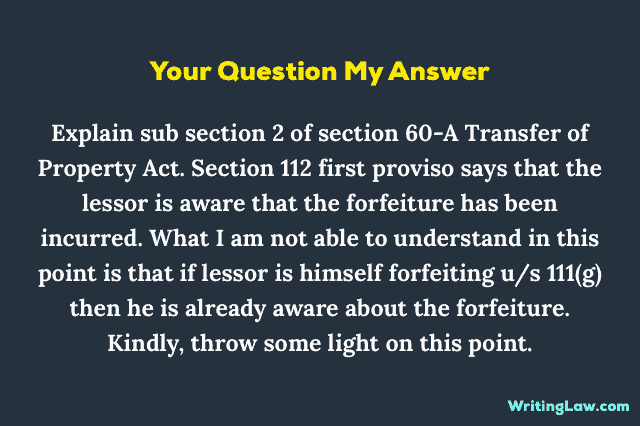
Section 60-A: A mortgagor is entitled for redemption after paying debt to mortgagee.
For example-
A is a mortgagor. He has taken amount of Rs. 50,000 from B and as a security he has mortgaged his immovable property (house) to B. Now if A has to transfer the concerned property to C, then he may direct B to transfer the property directly to C instead of transferring it to A.Read More →
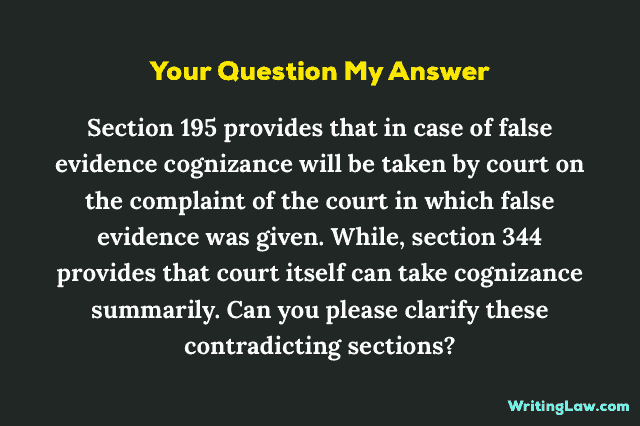
Section 195 and 344 are different in there own spheres. No section is inter-related or intervening to that of another.
Section 340 prescribes the procedure as to how a complaint is to be made under section 195.Read More →

1. The total number of ministers, including the Prime Minister in the Council of Minister should not exceed?
Ans. 15% of total members of Lok Sabha
2. Residuary powers vests in?
Ans. Parliament under Article 248Read More →
1. In how many years a sentence of imprisonment for life can be commuted by the Government?
Ans. 14 years
2. Which section of CrPC provides protection against double jeopardy?
Ans. Section 300Read More →
1. Evidence under the Evidence Act means and includes?
Ans. Ocular, oral and documentary. (Ocular means ‘connected with eyes or vision’)
2. The Indian Evidence Act has been divided into how many chapters and parts?
Ans. 3 Parts, 11 ChaptersRead More →
PDF for 20 law question and answers. These question are very short and and have one word or one sentence answers. These questions are important for various competitive law exams.
The 20 law questions in this PDF are mixed and of all kinds.
This randomness helps you prepare for exams that have multiple choice questions.Read More →
1. What is the enforcement date of Indian Contract Act?
Ans. 1 sep 1872
2. Which section says that an agreement without consideration is void?
Ans. Section 25 of Indian Contract ActRead More →

1. Common intention means?
Ans. Sharing of intention by all persons
2. The word good faith is defined under the Indian Penal Code in?
Ans. Section 52Read More →

1. The president’s rule under article 356 remains valid in the state for the maximum period of?
Ans. Six months
2. Article 39A of the Constitution deals with?
Ans. Equal justice and Free legal aidRead More →

1. When was the first meeting of constituent assembly held ?
Ans. 9th December 1946
2. Which article abolishes practice of untouchability?
Ans. Article 17 of the Constitution of IndiaRead More →

1. Which act provided for the establishment of supreme court at Calcutta in 1774?
Ans. The Regulating Act, 1773
2. Who became the first viceroy of India?
Ans. Lord Canning in 1858Read More →
1. By which act was the privy council abolished in India?
Ans. Privy council abolishment Act, 1949
2. Who administers oath to the Governor of a state?
Ans. Chief Justice of High Court (Article 159)Read More →

1. Rule of absolute liability was propounded by?
Ans. Justice P.N Bhagwati
2. The residuary power of legislation with parliament vests under which article?
Ans. Article 248Read More →

1. Under which article of the Constitution parliament can form a new state?
Ans. Article 3
2. Which article under Indian Constitution abolishes untouchability?
Ans. Article 17Read More →

1. Provision for setting aside ex-party decree is given under?
Ans. Order lX, Rule 13.
2. Which article of the Constitution provides for uniform civil code?
Ans. Article 44Read More →

1. Registration of a Hindu Marriage has been provided under?
Ans. Section 8 of HMA.
2. The statement “what cannot be done directly cannot be done indirectly” relates to the doctrine of-
Ans. Doctrine of colorable legislationRead More →
1. Confession caused by inducement, threat or promise is contained in-
Ans. Section 24 of Indian Evidence Act.
5. Necessity rule as to the admissibility of evidence is contained in-
Ans. Section 32Read More →